Advertisement
Advertisement
CTR Calculator
Calculate Click-Through Rate (CTR)
Determine the click-through percentage of your campaigns by entering total clicks and impressions.
Your Click-Through Rate (CTR)
Advertisement
Advertisement
What is CTR?
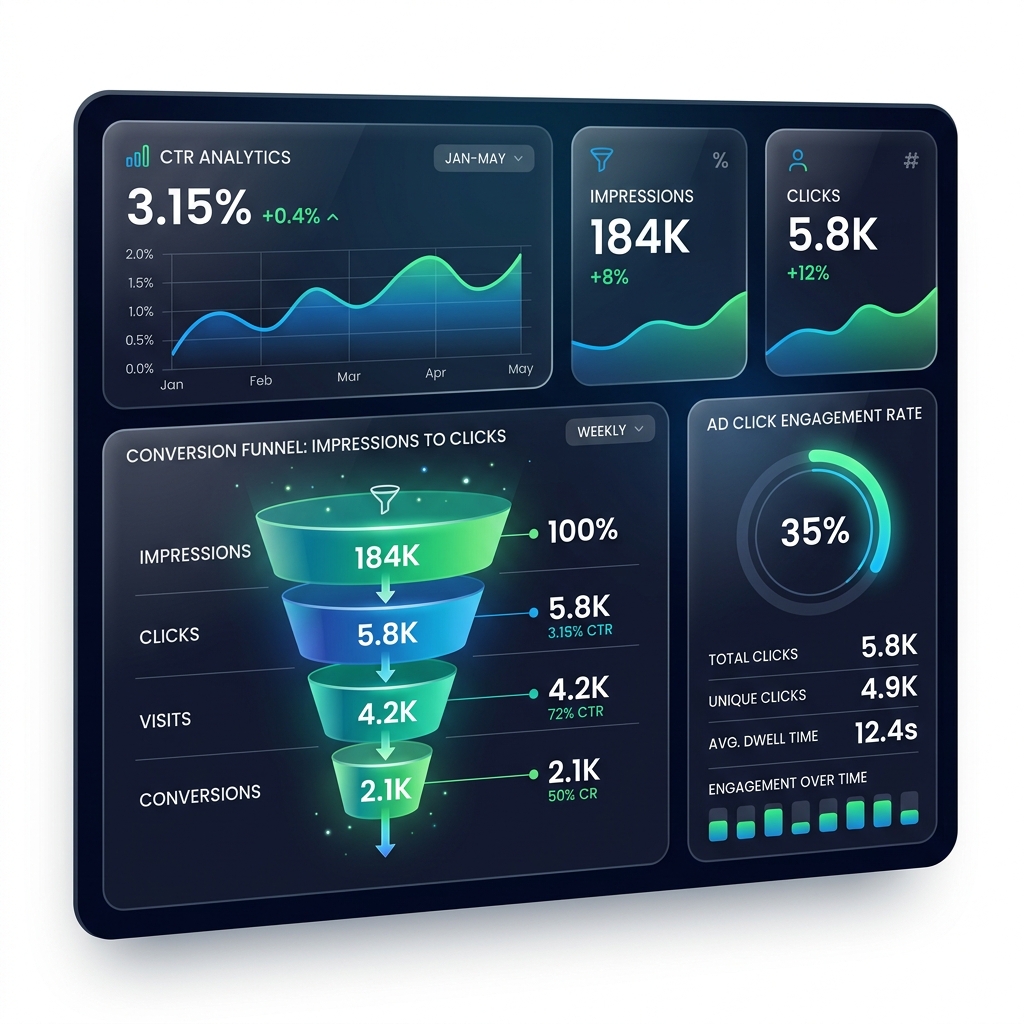
CTR stands for Click-Through Rate. It is a critical performance indicator in digital marketing, representing the percentage of impressions that result in an active click-through. In simple terms, it measures the proportion of viewers who saw your ad and decided to click it to learn more. CTR is a key signal used by Google Ads and social media networks to assess ad relevance and quality. Find the baseline unit costs with our main Cost Per Impression Calculator.
Tracking CTR helps you evaluate copy resonance and creative appeal. A high CTR indicates that your messaging connects with your audience, while a low CTR suggests your targeting or creatives need adjustment. Check your campaign CPM values with our CPM Calculator.
CTR and Auction Relevancy
Why do networks care about CTR? Because platforms like Google Ads and Meta earn revenue when users interact with ads (under CPC models). If your ad has a high CTR, the platform makes more money from your ad space than from a competitor's low-CTR ad. To reward you, the networks increase your Ad Quality Score, which decreases your actual CPC and wins you better placements at lower bids. Measure visitor costs using our interactive CPC Calculator.
The CTR Formula and Math
To calculate CTR, divide total clicks by total impressions, then multiply by 100 to convert the fraction into a percentage:
CTR Calculation Example:
Suppose you publish a promotional banner ad on a digital publication. The platform reports that the banner achieved 500,000 impressions and received 5,000 clicks. If you need help setting up tracking, visit our Contact Us page.
- Divide Clicks by Impressions:
5,000 / 500,000 = 0.01. - Convert to Percentage:
0.01 * 100 = 1.00%. - CTR Result: Your ad has a Click-Through Rate of 1.00%.
Advertisement
10 Expert Strategies to Improve Your Click-Through Rate (CTR)
While Click-Through Rate evaluates interaction ratios, your overall Cost Per Impression (CPI) determines how far your visual budget will stretch. Improving your CTR acts as a primary catalyst for lowering CPM and CPI, as ad exchanges reward highly engaging creatives with cheaper exposure fees. Here are 10 expert strategies to improve your Click-Through Rate (CTR) and optimize performance:
- Write Irresistible Headlines: Your headline is the first thing users notice. Draft clear, attention-grabbing titles that address user pain points, ask questions, or promise direct benefits to encourage click actions. Read the small business guide to Cost Per Impression.
- Create Compelling Calls-to-Action (CTAs): Tell users exactly what to do next. Use active, urgent verbs like 'Get Started Today', 'Download Free Guide', or 'Claim Discount Now' to drive immediate responses. Refer to the beginner guide to CPI.
- Leverage Ad Extensions: Sitelinks, callouts, and structured snippets add extra lines to search ads. This increases visual prominence on search results, giving users more reasons to click your ad. This is vital in programmatic advertising bidding.
- Target High-Intent Keywords: Focus on transactional and commercial search terms. Users searching for specific models or 'buy' options are far more likely to click than those searching for general info.
- Optimize Meta Descriptions: Write persuasive ad descriptions that expand on your headline. Outline unique selling propositions, trust badges, or special offers to make your ad stand out from competitors.
- Use Emotional Triggers: Touch on emotions like curiosity, urgency, or fear of missing out (FOMO). Highlighting limited-time offers or exclusive access creates a psychological incentive to click immediately.
- Perform Creative A/B Testing: Split test banner colors, layouts, and copy. Ad networks automatically prioritize the higher-performing variation, resulting in a steady, compounding improvement in campaign CTR.
- Exclude Low-Performing Audiences: Review demographic data and exclude segments that generate high impressions but zero clicks. Cleaning up targeting parameters concentrates impressions on engaged cohorts.
- Implement Countdown Timers: Use dynamic scripts to show remaining hours for a sale. Real-time countdowns build urgency directly in the ad unit, driving quick click-through actions.
- Align Ad with Landing Page: Maintain consistent messaging from the ad text to the landing page. Users are more likely to stay and engage when the transition feels seamless and matches expectations. Check ways to lower Cost Per Impression.
Cost Per Impression Benchmarks by Platform (2026)
Bidding dynamics continue to influence standard advertising rates across channels. While search environments focus on CPC, display and social networks buy visual real estate in blocks of 1,000 views. Below are the estimated average Cost Per Impression (CPI) and Cost Per Thousand (CPM) benchmarks for 2026:
| Platform | Average CPI (2026) | Average CPM (2026) | Billing Target Focus |
|---|---|---|---|
| Meta (Facebook & Instagram) | .0065 - .0125 | .50 - .50 | Demographic targeting & Social Feeds |
| Google Display Network (GDN) | .0010 - .0035 | .00 - .50 | Broad Web Display Placements |
| YouTube Ads | .0090 - .0220 | .00 - .00 | In-Stream Video Views & Ads |
| LinkedIn Ads | .0320 - .0750 | .00 - .00 | Professional Niches & Decision Makers |
| TikTok Ads | .0030 - .0080 | .00 - .00 | Mobile Video Stream Placements |
| Pinterest Ads | .0025 - .0070 | .50 - .00 | Creative Ideas & Retail Intent |
| Programmatic DSPs (Open Web) | .0015 - .0045 | .50 - .50 | Programmatic Real-Time Auctions |
These figures show that B2B targeting commands the highest CPM, whereas GDN and open programmatic options are extremely cost-effective for mass branding. For deep platform guides, read about Instagram Ads impression costs, check LinkedIn Ads metrics, and analyze the latest TikTok advertising benchmarks.
The Psychology of Ad Click-Through Rates (CTR)
A user's decision to click an ad is driven by immediate psychological triggers. The most effective ad creatives align with the user's current cognitive state. In search engine marketing, users are actively looking for solutions, so high-CTR ads address their search intent with precision. On social media feeds, users are browsing passively, so ads must disrupt their scrolling behavior using visual hooks, emotional resonance, or curiosity gaps. Understanding these behavioral motivators helps copywriters draft messages that command attention and drive clicks.
A/B Testing Creatives and Copy to Maximize Clicks
Systematically improving your Click-Through Rate requires structured A/B testing (or split testing). This process involves displaying two variations of the same ad (e.g., varying the headline, image layout, or CTA button text) to similar audience cohorts. Ad platforms automatically split traffic and measure which version yields the higher CTR. By continuously testing and replacing low-performing creatives, you steadily improve your campaign relevance scores, lowering your traffic costs and amplifying conversions.
Frequently Asked Questions
CTR stands for Click-Through Rate. It is the percentage of users who clicked on your ad out of the total number of users who saw it.
The CTR formula is: CTR = (Total Clicks / Total Impressions) * 100. It measures the ratio of interaction relative to total ad views.
CTR indicates how relevant and engaging your ad is to your target audience. Higher CTRs improve your quality scores and lower your CPC on major ad networks.
A good CTR depends on the marketing channel. Search ads average 3% to 5% CTR, while display ads are much lower, typically averaging 0.5% to 1%.
Use compelling copy, create clear calls-to-action (CTAs), A/B test ad visuals, and refine target parameters to align with user interest.
Advertisement
Other Advertising Metric Tools
Explore other specialized calculators to optimize bidding strategies and target media returns.
CPM Calculator
Calculate your cost per thousand impressions instantly to evaluate display placements.
CPC Calculator
Back out cost-per-click values from your total marketing spend and clicked links.
CTR Calculator
Measure the exact ratio of clicks relative to overall ad impressions displayed.
Cost Per Impression Calculator
Instantly compute CPM, CPC, CPI, CTR, and CPA together using our multi-metric tool.