Advertisement
Advertisement
CPM Calculator
Calculate Cost Per Thousand (CPM)
Determine your CPM (cost per 1,000 ad impressions) by entering total campaign budget and impressions.
Your Cost Per Thousand (CPM)
Advertisement
Advertisement
What is CPM?
CPM stands for Cost Per Mille, where 'Mille' is the Latin word for thousand. In digital advertising, CPM represents the cost an advertiser pays to deliver 1,000 impressions of their ad on a webpage, social media feed, or search interface. An impression is counted each time an ad is displayed to a user. This model is the standard currency for display advertising, programmatic media buying, and brand awareness campaigns. Find the baseline unit costs with our main Cost Per Impression Calculator.
Unlike Cost Per Click (CPC) bidding, which charges you only when a user actively clicks the ad, CPM charging occurs based entirely on exposure. If a placement delivers 1,000 impressions, you pay the agreed CPM fee regardless of click volume. This model helps marketers focus on wide visual exposure, product launches, and general brand reach. Compare this performance against click models using our CPC Calculator.
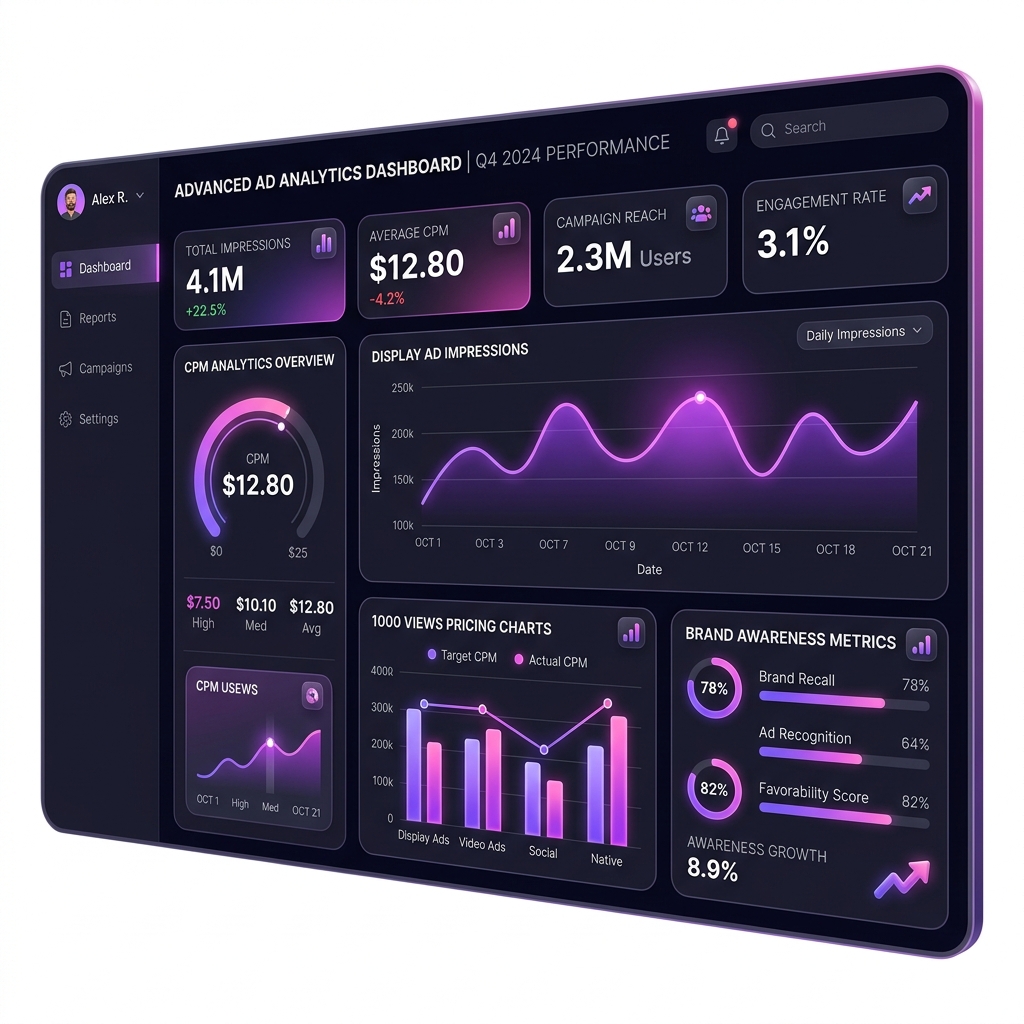
Dynamic CPM (dCPM) vs. Flat CPM
Modern programmatic ecosystems (like Google Display & Video 360 or Trade Desk) have moved away from flat, static CPM rates toward Dynamic CPM (dCPM). Under a dCPM model, the demand-side platform (DSP) uses machine learning algorithms to adjust your bid on an impression-by-impression basis. The system bids higher for impressions that carry a higher likelihood of conversion (e.g., users who have previously visited your site) and bids lower for low-value traffic, maximizing return on ad spend (ROAS).
The CPM Formula and Math
To calculate CPM, you divide the total advertising campaign budget by the total number of impressions, then multiply the result by 1,000. This scales the cost up from a single impression to a block of 1,000 impressions: Calculate your engagement percentage with our CTR Calculator.
CPM Calculation Step-by-Step Example:
Imagine your business runs a programmatic advertising campaign with a budget of $800.00. After one week, the ad networks report that the banner ad was displayed 250,000 times. For practical campaign calculations, see our interactive CPM Examples.
- Step 1: Divide Cost by Impressions:
$800.00 / 250,000 = $0.0032(unit Cost Per Impression). - Step 2: Multiply by 1,000:
$0.0032 * 1,000 = $3.20. - Step 3: Determine CPM: Your campaign has a CPM of $3.20.
Advertisement
10 Expert Strategies to Lower Your Cost Per Mille (CPM)
Because CPM is simply the Cost Per Impression scaled by 1,000, lowering your overall exposure rate is the key to maximizing visual reach. Bidding aggressively on competitive segments drains budgets quickly, while smart optimizations allow you to serve more ads for the same investment. Here are 10 expert strategies to lower your Cost Per Mille (CPM) and optimize your campaigns:
- Target Niche Audience Clusters: Bidding on broad, generic audiences places you in direct competition with massive brands. Focus on narrow, niche customer segments to bypass high-bid pools and secure lower CPM rates on display networks. Learn more in our small business guide to Cost Per Impression.
- Improve CTR and Ad Quality Scores: Search and social networks prioritize engaging ads that users interact with. Boosting click-through rates signals high relevance, which algorithms reward with a lower cost per thousand impressions. Refer to the beginner guide to CPI.
- Employ Bid Caps on DSPs: Avoid unconstrained automatic bidding. Set maximum CPM bid thresholds inside your Google Ads or programmatic consoles to prevent automated bidding software from buying overpriced ad inventory. This is vital in modern programmatic advertising bidding.
- Leverage Dayparting Ad Scheduling: Restrict your ad delivery to specific peak times of day when conversions are highest. This prevents serving impressions during unproductive night hours, saving budget and lowering average CPM.
- Enforce Strict Frequency Caps: Prevent ad fatigue by setting a limit on how often a single visitor sees your ad. A cap of 3-4 impressions per week protects your budget from repetitive, unproductive exposures.
- Block Low-Performance Placements: Regularly review domain reports and exclude hyper-casual mobile games, spammy websites, and low-traffic platforms that consume thousands of impressions without delivering active audience engagement.
- Focus on Mobile Placements: Mobile banner impressions typically cost less than desktop placements. Adjusting your device bids to favor mobile users reduces the average CPM of your overall marketing campaigns.
- Engage Warm Retargeting Cohorts: Serving display ads to users who have already visited your website drives better click behavior. Networks recognize this relevance and lower the CPM required to win these auctions.
- Utilize Native Placements: Native ads look like part of the publisher's site layout, bypassing banner blindness. They run on secondary ad exchanges that often demand lower base CPM rates than premium header-bid slots.
- Conduct Regular Creative A/B Tests: Frequently launch new ad variations to prevent audience blindness. Fresh creatives maintain higher interaction rates, which ad servers reward with lower entry CPM requirements. Review our guide on ways to lower Cost Per Impression.
Cost Per Impression Benchmarks by Platform (2026)
Bidding competition continues to alter standard placement pricing across major networks. Understanding average exposure rates helps media buyers allocate budget where it yields the best visibility. Below are the estimated average Cost Per Impression (CPI) and Cost Per Thousand (CPM) benchmarks for 2026:
| Platform | Average CPI (2026) | Average CPM (2026) | Primary Target Focus |
|---|---|---|---|
| Meta (Facebook & Instagram) | .0065 - .0125 | .50 - .50 | Social Feed Views & Demographics |
| Google Display Network (GDN) | .0010 - .0035 | .00 - .50 | Contextual Web Display Slots |
| YouTube Ads | .0090 - .0220 | .00 - .00 | Pre-Roll & In-Stream Video Views |
| LinkedIn Ads | .0320 - .0750 | .00 - .00 | Corporate Decision Makers & B2B |
| TikTok Ads | .0030 - .0080 | .00 - .00 | Mobile Short-form Video Exposure |
| Pinterest Ads | .0025 - .0070 | .50 - .00 | Visual Intent & Creative Planners |
| Programmatic DSPs (Open Web) | .0015 - .0045 | .50 - .50 | Programmatic Open Auction bidding |
These averages indicate that B2B placements on LinkedIn require higher investment, while display syndicates like Google Display Network remain the cheapest channel for wide branding exposure. For platform insights, read about Instagram Ads impression costs, check LinkedIn Ads metrics, and analyze the latest TikTok advertising benchmarks.
Factors Influencing Programmatic CPM Rates
CPM rates are not arbitrary; they are determined by real-time bidding demand in open exchanges. Key factors include:
- Audience Value: Highly specific, high-income target demographics command a premium. Targeting C-level executives in the B2B tech industry will cost significantly more than targeting general consumers.
- Geographic Location (Geo): Countries with high purchasing power (Tier 1 markets like the US, UK, Germany, Canada) have much higher CPMs than Tier 3 markets.
- Seasonality: Bidding competition peaks during holiday sales seasons (Q4, Black Friday, Cyber Monday), raising industry-wide CPMs.
- Ad Placement and Format: Header banners, sticky sidebar units, interstitial video units, and larger format ads have higher CPMs than standard 300x250 sidebar boxes.
Real-Time Bidding (RTB) Auctions and CPM Mechanics
In programmatic advertising, display ad inventory is bought and sold in milliseconds through automated auctions known as Real-Time Bidding (RTB). When a user visits a webpage, the publisher's site sends a bid request to an ad exchange, including metadata such as page context and browser history. Advertisers use Demand-Side Platforms (DSPs) to set bid parameters and CPM values. The DSP automatically bids on behalf of the advertiser in real time. The highest bidder wins the auction, and their banner ad renders on the page. Understanding these RTB mechanics helps digital buyers evaluate why their average CPM changes depending on platform bidding density and target audience specificity.
Dynamic CPM (dCPM) Optimization in Modern DSPs
Modern ad buying consoles have transitioned from static flat CPM bidding to Dynamic CPM (dCPM). Under dCPM, algorithms automatically adjust your bidding amount on an impression-by-impression basis. If the algorithm determines that a specific user has a high probability of converting (e.g., they previously added items to a shopping cart), it will bid higher than your baseline CPM to secure the placement. Conversely, for lower-intent users, the system will bid significantly lower. This dynamic scaling helps maximize return on investment (ROI) by matching impression costs with intent value.
Frequently Asked Questions
CPM stands for Cost Per Mille (Mille is Latin for thousand). It is a standard pricing model representing the cost of delivering 1,000 ad impressions.
The CPM formula is: CPM = (Total Campaign Cost / Total Impressions) * 1,000. It scales the unit impression cost up to a thousand units for easier comparison.
Because display ads receive large volumes of impressions, displaying single impression costs (like .0035) is impractical. Measuring in blocks of 1,000 units provides cleaner pricing numbers.
Targeting specificity, seasonality (costs rise in Q4), ad placements, bidding strategies, and competition in target industries all impact CPM rates.
Expand your audience targeting slightly if it is too narrow, use high-performing ad formats, improve ad quality, and audit placements to filter out low-value sites.
Advertisement
Other Advertising Metric Tools
Explore other specialized calculators to optimize bidding strategies and target media returns.
CPM Calculator
Calculate your cost per thousand impressions instantly to evaluate display placements.
CPC Calculator
Back out cost-per-click values from your total marketing spend and clicked links.
CTR Calculator
Measure the exact ratio of clicks relative to overall ad impressions displayed.
Cost Per Impression Calculator
Instantly compute CPM, CPC, CPI, CTR, and CPA together using our multi-metric tool.