Advertisement
Advertisement
CPC Calculator
Calculate Cost Per Click (CPC)
Determine the exact cost of each individual click by entering your total ad spend and total click volume.
Your Cost Per Click
Advertisement
Advertisement
What is CPC?
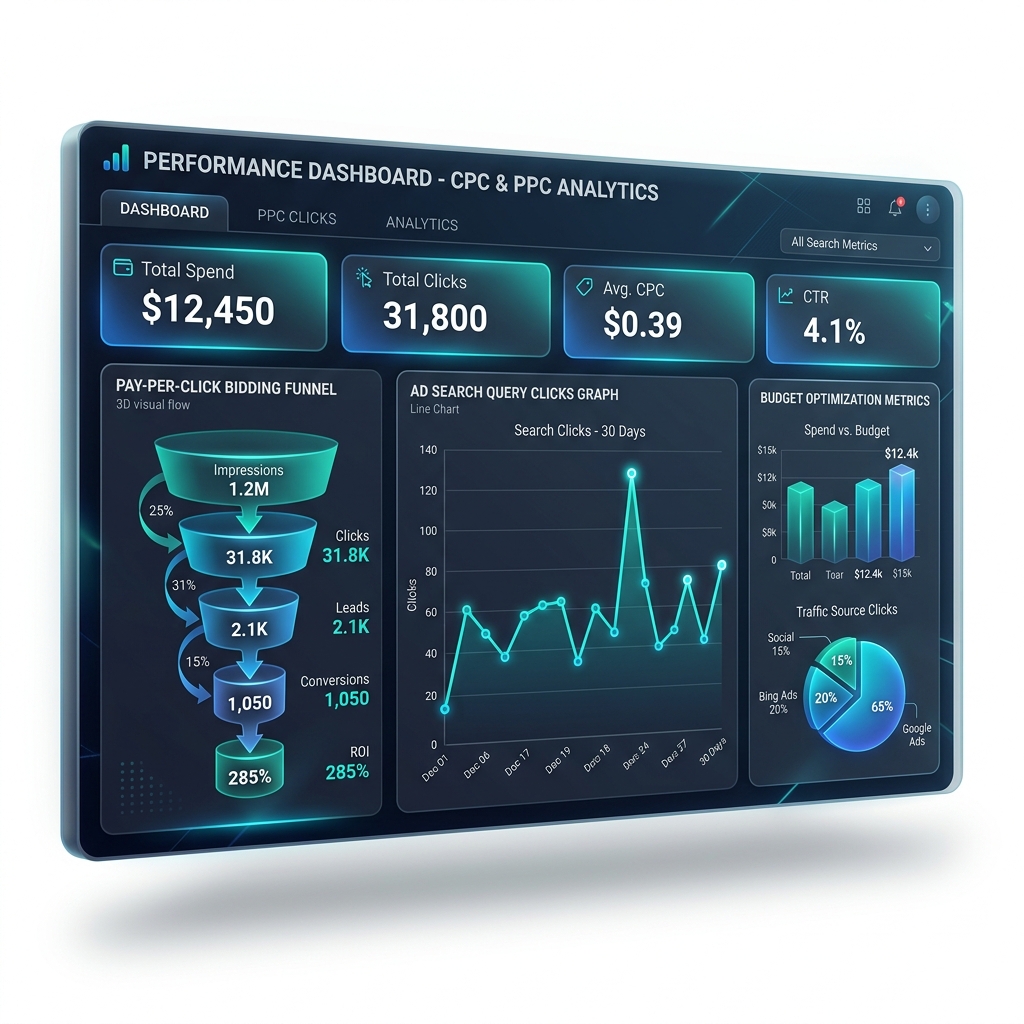
CPC stands for Cost Per Click. It is a dominant billing method in search engine marketing and social advertising. Under this model, advertisers pay only when a user actively clicks on their ad to visit their website or landing page. It is highly valued for direct response and traffic campaigns because you do not pay for passive views (impressions), only for active engagement. Calculate your baseline exposure rates with the Cost Per Impression Calculator.
CPC calculations are critical for evaluating campaign performance. By tracking how much each visitor costs, you can balance acquisition costs against visitor values, calculate conversion rates, and build a profitable marketing funnel. Compare your campaign budget efficiency using our CPM Calculator.
How CPC is Determined: Google Ads Auction & Quality Score
In search advertising (like Google Ads), you do not simply pay your maximum bid. Instead, you pay the minimum amount required to beat the competitor immediately below you. This is calculated using the Google Ad Rank formula:
When an auction occurs, your actual CPC is calculated as:
The CPC Formula
The baseline calculation divides total campaign budget by the total clicks generated. The resulting figure represents the average cost per visitor:
CPC Calculation Example:
Suppose you run a Google Search campaign for your local plumbing service. Over a month, you spend a total budget of $600.00, and the dashboard reports that your ads received 200 clicks. To know more about our campaign auditing mission, read our About Us page.
- Divide Cost by Clicks:
$600.00 / 200 = $3.00. - CPC Result: Your campaign averages a Cost Per Click of $3.00.
Advertisement
10 Expert Strategies to Lower Your Cost Per Click (CPC)
Although this tool evaluates clicks, your Cost Per Impression (CPI) remains the ultimate foundation of your traffic budget, as every click originates from served impressions. Lowering the exposure rates of your campaign decreases your overall spend, directly leading to a more efficient Cost Per Click (CPC). Here are 10 expert strategies to lower your Cost Per Click (CPC) and optimize performance:
- Boost Ad Quality Scores: Ad networks like Google Ads determine CPC based on Quality Score, which measures relevance and CTR. Improving your ad copy alignment and landing page experience increases your score, directly lowering CPC. Read our small business guide to Cost Per Impression.
- Utilize Negative Keywords: Regularly audit search terms and add negative keywords to filter out irrelevant searches. This prevents paying for clicks from users who have no intention of buying your products. Refer to the beginner guide to CPI.
- Target Long-Tail Keywords: Highly competitive broad-match keywords demand premium bids. Bid on specific, multi-word long-tail keywords which have lower competition and cost per click, while delivering highly qualified traffic. This is vital in modern programmatic advertising bidding.
- Refine Ad Copy Match: Ensure your ad headings match the user's search query exactly. High contextual alignment drives higher click rates, signals relevance to the networks, and lowers bid requirements.
- Optimize Landing Page Speed: Fast, mobile-responsive landing pages with low bounce rates improve your quality metrics. Networks reward a high-quality landing page experience with cheaper cost per click options.
- Apply Bid Adjustments by Device: Check conversion rates across mobile, desktop, and tablet. Lower your bids on devices that yield high CPCs but low sales, maximizing click efficiency.
- Schedule Ads via Dayparting: Limit ad display to days and hours when historical data shows users are most likely to click and convert, avoiding waste during low-interaction periods.
- Improve Ad Extensions: Add sitelinks, callouts, and structured snippets to make your search ads larger and more informative. This increases CTR without raising your base bid, which helps lower CPC over time.
- Segment Campaigns Geographically: Audit cost performance by location. Reduce bids in highly competitive, expensive geographic zones and reallocate budget to areas that yield cheaper, high-converting clicks.
- A/B Test Ad Variations: Continuously test different ad copy, descriptions, and calls-to-action. Running top-performing variations maintains strong relevance scores, keeping CPC as low as possible. See ways to lower Cost Per Impression.
Cost Per Impression Benchmarks by Platform (2026)
Pricing changes across networks continue to impact campaign delivery costs. While search ads are billed on clicks, social and display media are bought on impressions. Below are the estimated average Cost Per Impression (CPI) and Cost Per Thousand (CPM) benchmarks for 2026 across major networks:
| Platform | Average CPI (2026) | Average CPM (2026) | Primary Bidding Target |
|---|---|---|---|
| Meta (Facebook & Instagram) | .0065 - .0125 | .50 - .50 | Demographics & Social Feed Banners |
| Google Display Network (GDN) | .0010 - .0035 | .00 - .50 | Contextual Site Banners & Apps |
| YouTube Ads | .0090 - .0220 | .00 - .00 | Video Pre-Roll & Mid-Roll views |
| LinkedIn Ads | .0320 - .0750 | .00 - .00 | B2B Professional Segments |
| TikTok Ads | .0030 - .0080 | .00 - .00 | Mobile Video Stream Placements |
| Pinterest Ads | .0025 - .0070 | .50 - .00 | Lifestyle Discovery & Pin Boards |
| Programmatic DSPs (Open Web) | .0015 - .0045 | .50 - .50 | Programmatic Exchanges & Exchanges |
These benchmarks emphasize that B2B placements command premium rates, while open display networks like Google Display Network represent the most cost-efficient channels. For detailed platform guides, read about Instagram Ads impression costs, check LinkedIn Ads metrics, and analyze the latest TikTok advertising benchmarks.
Google Ads Auction Math: Max Bid vs. Actual CPC
In search engine advertising (such as Google Ads), the bidding system operates on a generalized second-price auction. This means you do not pay your maximum bid when your ad is clicked. Instead, your actual Cost Per Click is the minimum amount required to maintain your ad position above the competitor immediately below you. Mathematically, it is calculated by dividing the Ad Rank of the competitor below you by your Quality Score, and then adding one cent. This math indicates that you can achieve a lower actual CPC even with a lower bid, provided your Quality Score is significantly higher than your competitors.
How Quality Score and Landing Page Relevance Lower CPC
Your Quality Score is Google's diagnostic tool measuring the quality and relevance of your search ads. It is scored from 1 to 10 based on three core components: expected Click-Through Rate (CTR), ad relevance to the search query, and landing page experience. By writing highly aligned copy and designing fast, mobile-friendly landing pages, you boost your Quality Score. Because Quality Score is the denominator in the actual CPC equation, doubling your score can reduce your traffic costs by half, keeping your digital marketing campaigns highly profitable.
Frequently Asked Questions
CPC stands for Cost Per Click. It is a digital marketing pricing model where you pay a fee each time a user clicks your advertisement to visit your landing page.
The CPC formula is: CPC = Total Campaign Cost / Total Clicks. For example, if you spend and get 50 clicks, your CPC is .00.
CPC is a vital metric for evaluating traffic-generation campaigns. It tells you exactly how much you pay to attract a prospective customer to your website.
They are inversely proportional. As your Click-Through Rate (CTR) increases, ad networks reward you with lower CPCs due to high relevance scores.
Improve your ad copy to boost CTR, refine keyword targeting, optimize landing page experience, and work on your ad relevance scores.
Advertisement
Other Advertising Metric Tools
Explore other specialized calculators to optimize bidding strategies and target media returns.
CPM Calculator
Calculate your cost per thousand impressions instantly to evaluate display placements.
CPC Calculator
Back out cost-per-click values from your total marketing spend and clicked links.
CTR Calculator
Measure the exact ratio of clicks relative to overall ad impressions displayed.
Cost Per Impression Calculator
Instantly compute CPM, CPC, CPI, CTR, and CPA together using our multi-metric tool.